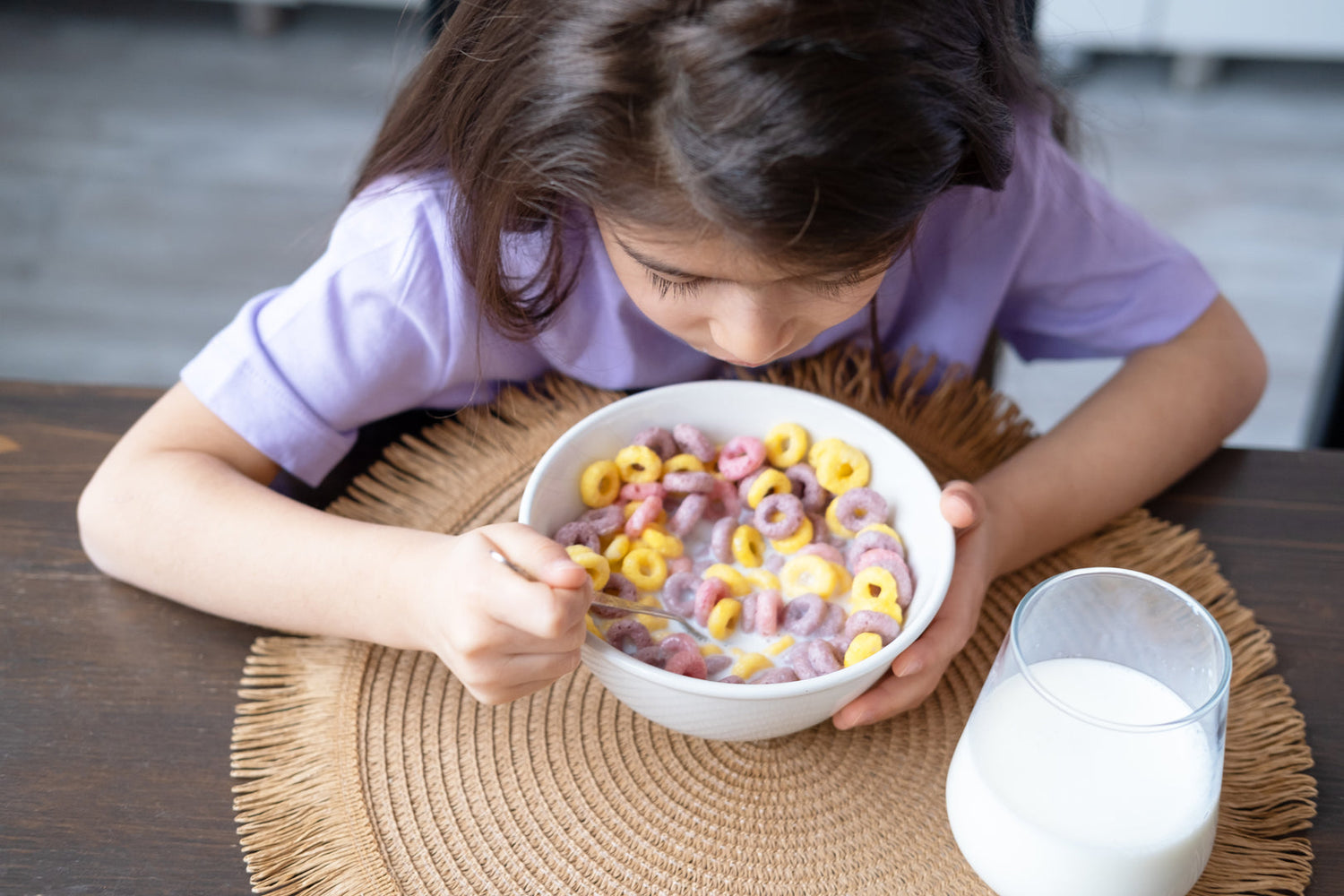
You know the scene. It's 7:15am, the morning is already running ten minutes behind, and your children are clamouring for their favourite cereal. The one with the cartoon mascot. The one they saw advertised between episodes of something loud.
You pour it. They eat it. Everyone leaves the house on time. Job done.
But have you ever flipped the box over and actually looked at what's in there? Because the gap between what the front suggests and what the back reveals can be... eye-opening.
The numbers are worth knowing
Action on Sugar, a UK-based research group, analysed popular children's cereals and found some results that are hard to ignore ᵃ.
Some cereals marketed at children contain up to 70% sugar by weight. That's not cereal with added sugar — that's essentially a sprinkling of cereal with a side of sugar. (You know who you are, cartoon mascot.)
Others contain around 40g of sugar per 100g — more than three times the recommended daily intake for a young child, in a single bowl.
For context: the NHS recommends no more than 24g of added sugar per day for children aged 7–10. A generous serving of some popular cereals blows past that before they've even left the house.
And that's before anyone's mentioned toast. Or juice. Or the biscuit they somehow negotiated on the way out the door.
It's not just cereal
The sugar question extends beyond the breakfast bowl — which is both useful to know and mildly exhausting.
A popular children's yoghurt contains around 8g of sugar per small pot — roughly the same as a small chocolate bar. (The pot with the friendly animal on the front. Yes, that one. We were surprised too.)
A common lunchbox soft drink (200ml) delivers the equivalent sugar of a Kinder Bueno, plus multiple sweeteners. The marketing says "no added sugar." The ingredient list tells a different story.
Some products marketed as "healthy" contain three or four different types of sugar — each listed separately so none appears first on the ingredient list. Sneaky? More than a bit.
Breakfast drinks, smoothies and fruit juices (especially from concentrate) also count as free sugars. They're easy to overlook — especially when the packaging features smiling fruit — but they add up quickly.
The many names of sugar
Sugar doesn't always announce itself clearly. It's not trying to be found.
On ingredient lists, it can appear as:
- Glucose
- Fructose
- Maltose
- Dextrose
- Corn syrup
- Maltodextrin
- Glucose-fructose syrup
If several of these appear in one product, they're stacking up — even if none of them sits at the top of the list.
Time to channel your inner cereal sleuth. (Magnifying glass optional. Reading glasses, possibly not.)
Why it matters
This isn't about perfection or never allowing anything sweet. Children eat cake at parties. They have ice cream in summer. Life's too short for an utterly sugar-free existence — and honestly, that's not the goal.
It's about patterns. The quiet, daily defaults that add up over weeks and months without anyone really noticing.
Regular high-sugar breakfasts have been linked to longer-term preferences for sweet foods, which can affect eating habits well beyond childhood (b).
There's also evidence connecting high free-sugar intake to increased risk of weight gain, dental issues and other health outcomes over time (c).
Starting the day with a big sugar hit can also affect energy and concentration — the familiar spike-and-crash that leaves children flagging by mid-morning. Teachers know this pattern. Parents know it too. (It's the "why are you crying about your socks?" meltdown, roughly 10:47am.)
What actually helps
Small shifts tend to stick better than dramatic overhauls. Nobody's suggesting you bin everything and start again on Monday. That way lies madness and wasted groceries.
Read, read, read. The front of the box is marketing — designed by people who are very good at their jobs. The nutrition label and ingredient list tell you what's actually in there. Anything above 15g of sugar per 100g is worth noticing.
Compare before you buy. Sugar content varies wildly between brands — even between products that look almost identical. A quick comparison can make a real difference over time. (Yes, it adds thirty seconds to the shop. Yes, it's worth it.)
Go for lower-sugar bases. Porridge, plain wheat biscuits, bran flakes and unsweetened oat-based cereals are all solid starting points. They might need a bit of help — fruit, a drizzle of honey, some nuts or seeds — but you're in control of what goes on. That's the difference.
Get creative with toppings. Fresh fruit, a few berries, a sliced banana — these add flavour and natural sweetness without the refined sugar load. And children often accept sweetness better when they've added it themselves. (Autonomy: the secret weapon of breakfast negotiation.)
The bigger picture
Cereal isn't the enemy. It's convenient, familiar, and often the only thing standing between a child and an empty stomach on a school morning. We've all been there. We'll all be there again tomorrow.
But knowing what's actually in the box — and making small swaps where it's easy — can quietly improve the nutritional quality of breakfast without requiring a complete overhaul or a 5:30am alarm.
Not perfection. Just a bit more awareness, one label at a time.
And if today's breakfast was a sugar-coated compromise because everyone overslept and the morning was already on fire — that's fine too. Tomorrow's another bowl.
Come and say hello
There's a growing community of fellow saints on Instagram — come say hello. Or leave your email, and we'll drop into your inbox now and then with things worth reading.
This is general information, not medical advice. If you have questions about your child's health, your GP or a registered healthcare professional is always the right place to start.
References
(a) Action on Sugar. Children's cereal survey. https://www.actiononsugar.org/ (b) Ventura AK, Mennella JA. (2011). Innate and learned preferences for sweet taste during childhood. Current Opinion in Clinical Nutrition and Metabolic Care. (c) Scientific Advisory Committee on Nutrition (SACN). (2015). Carbohydrates and Health. Public Health England.
Authorised nutrition and health claims are listed separately in the page footer.