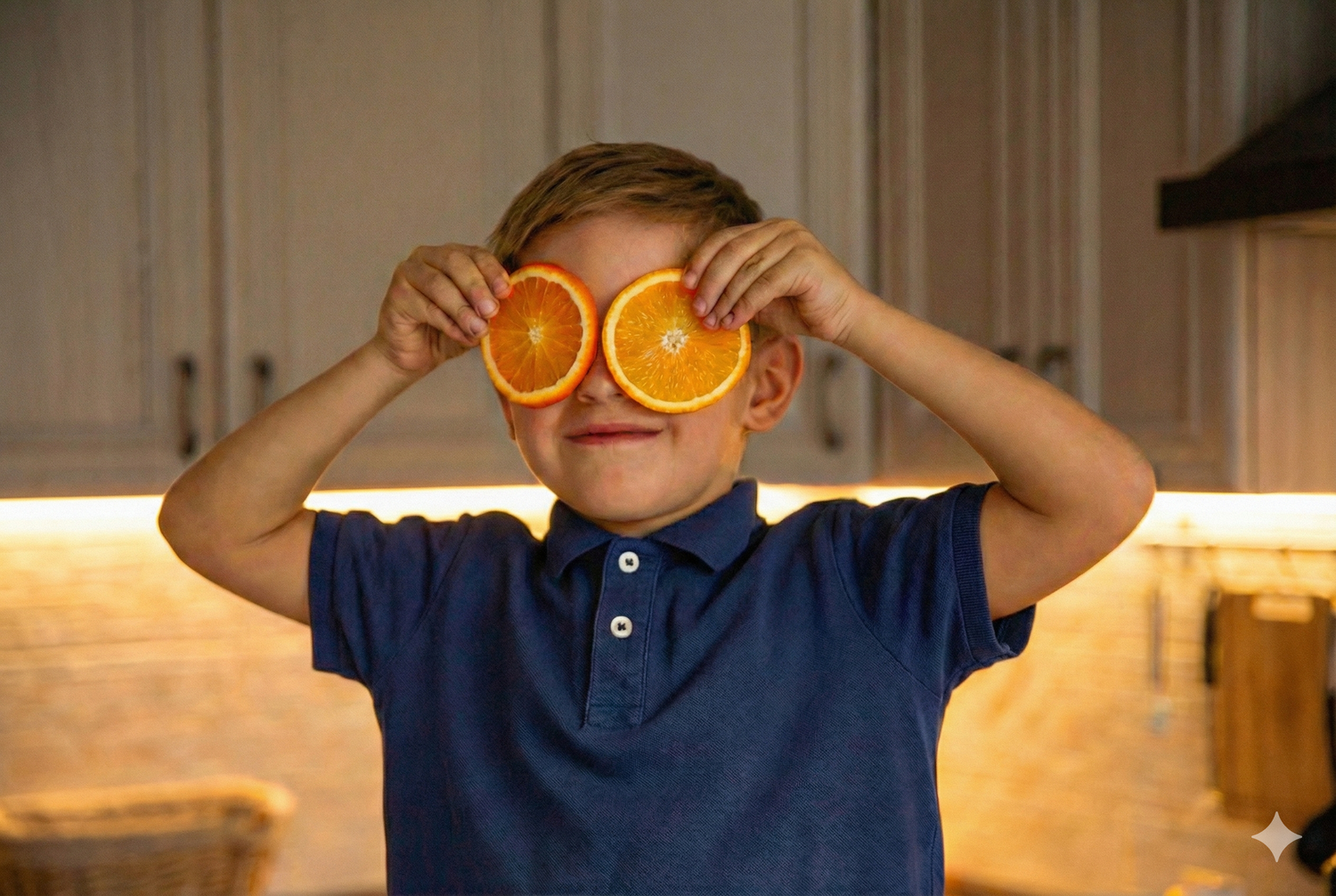
Let's talk about vitamin C — the bright, tangy nutrient that quietly keeps your child's body ticking along nicely. It's like an unseen helper working behind the scenes: supporting immune defences¹, helping cuts and scrapes heal, and keeping skin, gums and tissues sturdy.
Even 18th-century sailors learnt the hard way that without enough vitamin C, you could end up with scurvy — bleeding gums and all. True scurvy is extremely rare nowadays ᵃ. Still, modern diets — with picky phases and convenience foods — can mean some children don't get much fruit and veg day to dayᵇ.
The good news: vitamin C is one of the easiest nutrients to sort with a few small, repeatable habits.
What's the big deal about vitamin C, anyway?
Vitamin C isn't just about colds. It's a proper multitasker.
Immune support
Vitamin C supports normal immune function in children¹. It's involved in immune cell function and supports the body's protective processes — useful when school is basically a petri dish with spelling tests ᶜ.
Wound healing and skin health
Vitamin C is crucial for making collagen, the protein that helps hold skin, cartilage, blood vessels and tissues together ᶜ. In child-friendly terms: collagen is the glue and scaffolding that helps their bodies stay held together when they're living at full speed.
Strong gums, teeth and bones
Because collagen supports gum structure and connective tissues, vitamin C plays a role in keeping gums and oral tissues robust ᶜ. Children low in vitamin C can develop tender or bleeding gums over time ᶜ.
Iron absorption for energy
If your child isn't keen on meat (or is in their "I only eat beige" era), vitamin C helps with iron absorption³. It's basically the helpful friend who makes sure iron from food actually gets invited in.
Antioxidant protection
Vitamin C contributes to the protection of cells from oxidative stress¹. Think of it as a little "anti-rust" support crew for the body — helping protect cells as they grow and develop.
The detective's guide: spotting low vitamin C
If your child is a bit light on fruit and veg, mild vitamin C shortfalls can show up in ways that look… annoyingly normal. Here are some clues worth noticing ᵃᶜ.
The constantly Sniffly Child
Children catch colds — that's childhood. But if your child seems to catch everything and takes ages to bounce back, diet is one factor worth checking, including vitamin C intake ᵃᶜ.
The mystery bruises
Vitamin C helps support connective tissues and blood vesselsᶜ. If bruises appear from the gentlest bumps, it can be one sign among many to look at fruit and veg intake ᵃᶜ.
The slow-healing wounds
Because collagen is part of how skin repairs, low vitamin C can contribute to slower healing ᵃᶜ. If a scrape seems to stay angry-looking forever, it's a nudge to check the basics.
Gum troubles (bleeding or swollen)
If gums bleed easily or look puffy and tender, vitamin C intake is worth reviewing ᵃᶜ.
The tired and grumpy one
If your child seems more tired than usual, vitamin C may be part of the bigger picture — including because it supports iron absorption³ and contributes to the reduction of tiredness and fatigue⁷.
This doesn't explain every tired day (growth spurts are their own personality), but it's one of those "worth checking" areas.
The serious stuff (rare, but worth knowing)
Severe, long-term deficiency can lead to scurvy symptoms like swollen bleeding gums, leg pain and profound fatigue ᵃ. Again: extremely rare — but it's why vitamin C got its dramatic reputation in the first place.
Key takeaway: mild gaps are far more common than scurvy, and far easier to sort ᵃᶜ.
The colourful menu: vitamin C-rich foods children (usually) love
Vitamin C is very gettable from food — when food is cooperating.
Citrus Favourites
Oranges, clementines, tangerines, grapefruit. A medium orange can provide a strong hit of vitamin C.
Parent move: orange slices, citrus fruit pots, or mini fruit lollies made from blended fruit.
Berry Bonanza (and Kiwi)
Strawberries, raspberries, blackcurrants, kiwi — all great vitamin C sources. Blend into yoghurt, porridge, smoothies… or serve as "snack tax" while they're asking for snacks.
The Crunchy Ones
Bell peppers are unexpectedly brilliant for vitamin C. Broccoli and Brussels sprouts also contribute well .
Surprising Sources
Potatoes contribute a bit too. Not huge — but given how often potatoes appear in children's diets, it can add up.
Simple Strategy
Aim for two vitamin C-rich choices daily (fruit plus veg is easiest). Frozen fruit and veg still count — and often make life simpler.
When Hunger Does the Work
Leave a plate of chopped fruit and veg out when they're absolutely ravenous — after school, after sports, or right before dinner.
This is the window where their resistance is at its lowest and their stomach is doing the decision-making. I have watched children who "hate peppers" mysteriously eat an entire plate of pepper sticks in this state, then later claim they "didn't" We quietly accept the win and move on.
Food first… and then real life happens
In theory, food covers everything. In practice, children are sometimes unpredictable little creatures who can survive on toast, air and moral superiority.
This is where supplements can be useful — as a consistent way to support intake when diet is limited, repetitive, or just going through a phase.
Understanding vitamin C forms: ascorbic acid
Ascorbic acid is a well-studied form of vitamin C, and research suggests it's bioavailable in a similar way to vitamin C from many food sources. It's widely used for good reason: it works, it's researched, and it does the job.
Reassurance and practical takeaways
If your child eats some fruit and veg regularly, they're probably doing fine on vitamin C.
If they don't (right now), that's not a character flaw — it's just a phase to work around.
Children's tastes change faster than their socks. One week they love strawberries; the next week they behave like you've offered them radioactive slime. This is annoyingly normal.
You're already doing the most important thing: noticing what matters, and building small habits that stick.
Here's to strong immune systems¹, scrapes that heal, and parents who deserve a medal — or at least an uninterrupted cup of tea.
Come and say hello
There's a growing community of fellow saints on Instagram—come say hello. Or leave your email, and we'll drop into your inbox now and then with things worth reading.
This is general information, not medical advice. If you have questions about your child's health, your GP or a registered healthcare professional is always the right place to start.
Supporting references
(a) Maxfield L, Daley SF, Crane JS. Vitamin C Deficiency. StatPearls.
(b) Public Health England. National Diet and Nutrition Survey (NDNS) Years 9–11: Statistical Summary.
(c) National Institutes of Health, Office of Dietary Supplements. Vitamin C – Fact Sheet.
(d) Mangels AR, Block G, Frey CM, et al. (1993). Bioavailability of ascorbic acid from oranges, orange juice and cooked broccoli is similar to synthetic ascorbic acid. Journal of Nutrition.
(e) NHS. Vitamin C – Vitamins and minerals.
Authorised nutrition and health claims are listed separately in the page footer.