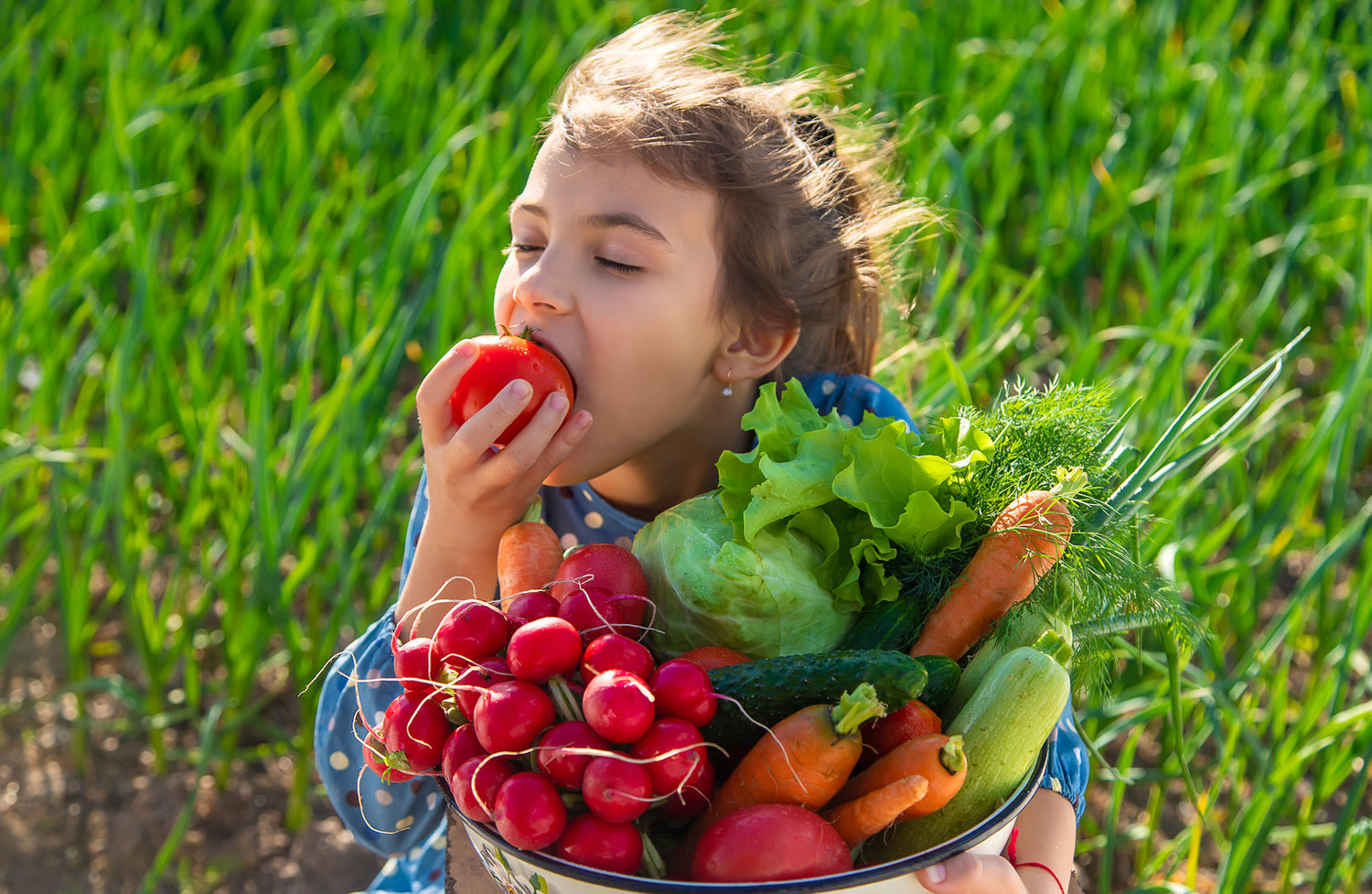
It's 6pm. You're standing in the kitchen, staring at three children with completely different food preferences.
One devours strawberries but won't touch carrots. Another loves broccoli but refuses anything red. The third would happily survive on toast and sheer determination.They've done the research. Apparently toast is a complete food group now.
It's less "family dinner" and more restaurant with three extremely opinionated critics.
Here's the reassuring bit: any fruit and veg is helpful. You're already doing something right.
But over time, variety — especially colour — does matter.
Different colours bring different nutrients, and children's bodies use them all in slightly different ways.
Why colour matters
Plants make natural compounds called phytonutrients. They help plants survive things like sun exposure and pests — and when we eat them, they support everyday processes in the body tooᵃ.
Different colours mean different phytonutrients. That's why variety matters more than obsessing over any single "super" food.
Research consistently shows that diets rich in a range of fruits and vegetables are linked to healthier immune systems, heart health, and long-term wellbeing — in children and adults alikeᵇ ᶜ.
No single food does everything. It's the combination that counts.
The colour-by-colour guide
Think of this less like a checklist and more like a painter's palette — you don't need every colour every day, but over time, the more variety, the broader the coverage.
🔴 Red: the cell protectors
Red fruits and vegetables contain compounds like lycopene, which act as antioxidants — helping protect cells from everyday wearᵃ.
They're also often rich in vitamin C, which supports normal immune function¹.
Try: cherry tomatoes, strawberries, watermelon, red peppers, raspberries, red apples, beetroot.
🟠 Orange: the ones for eyes and growth
Orange foods are rich in beta-carotene, which the body converts into vitamin A — important for vision and cell development⁶ ⁸.
Try: carrots, sweet potato, mango, orange segments, apricots, butternut squash.
Sweet potato wedges are doing more than you'd think. And they usually get eaten — which, frankly, is half the battle.
🟡 Yellow: the immune supporters
Yellow foods often bring vitamin C and other carotenoids, supporting immune function and helping the body absorb iron¹ ³.
Try: bananas, sweetcorn, pineapple, yellow peppers, golden kiwi, yellow courgette.
🟢 Green: the heavy lifters
Green vegetables deliver folate, fibre, magnesium, and plant compounds that support digestion, growth, and nervous system function² ⁴ ⁵.
Try: broccoli, peas, spinach (blended works — what they don't know won't hurt them), avocado, cucumber, green beans, kiwi.
Peas are the unsung heroes of the vegetable world. Small, freezable, and surprisingly accepted by children who reject all other green things.
🔵🟣 Blue and purple: the brain supporters
Blue and purple foods contain anthocyanins — compounds that can cross the blood–brain barrier and help protect brain cellsᵈ.
They're also associated with antioxidant support¹.
Try: blueberries, blackberries, purple grapes, plums, red cabbage, purple sweet potato.
Frozen blueberries in yoghurt. That's it. That's the hack. (Also works as a bribe. We're not judging.)
🟤 White and brown: the ones people forget
White and brown foods often contain compounds like allicin and quercetin, linked to immune and gut supportᵃ ᵉ.
Not glamorous — but very useful.
Try: cauliflower, mushrooms, onions (cooked into things), garlic (same), parsnips, dates.
Mushrooms disappear into bolognese. Garlic disappears into everything. Stealth nutrition at its finest.
How much is "enough"?
A handful of berries counts. Frozen peas count. Veg hidden in the sauce counts. If it's in a smoothie and they drank it, it counts.
When the rainbow looks more like... beige
Some days your child will eat a range of colours.
Other days, they'll eat three peas and declare victory.
Both are normal.
Whole foods come first — but real life includes weeks where variety dips, appetites swing, and the same four foods rotate until everyone loses track of what day it is.
Research into fruit and vegetable powders suggests they can meaningfully raise circulating nutrients like carotenoids, vitamin C, and folateʰ ⁱ. Used sensibly, they can support nutrition when variety isn't happening — without replacing food.
Small ways to add more colour (without a standoff)
- Lead by example — children copy more than we realise, even when they're pretending not toᵍ.
- Make it playful — colours, shapes, silly names, food that comes with a story.
- Involve them — choosing veg increases the odds of eating itᵍ.
- Blend and fold — sauces, soups, smoothies, anything that hides evidence.
- Time it well — hungry after school or sport is often the golden window.
The bigger picture
Rainbow eating isn't about getting it right every day. It's about coverage across weeks and months — a bit of this, a bit of that, building up gradually.
Some days will be colourful.Some days will be toast dipped in ketchup and called "a balanced meal."
You're still doing the work.
And if you've ever celebrated a child eating one unexpected bite of something green — you're very much not alone.
Come and say hello
There's a growing community of fellow saints on Instagram—come say hello. Or leave your email, and we'll drop into your inbox now and then with things worth reading.
This is general information, not medical advice. If you have questions about your child's health, your GP or a registered healthcare professional is always the right place to start.Supporting references
References
ᵃ McManus, K. Phytonutrients: Paint your plate with the colors of the rainbow. Harvard Health Publishing. ᵇ British Dietetic Association. Fruit and vegetables – how to get five-a-day. ᶜ Better Health Channel. Antioxidants and free radicals. ᵈ Cleveland Clinic. Health benefits of anthocyanins. ᵉ Better Health Channel. Quercetin and plant compounds. ᶠ NHS UK. 5 A Day: what counts? ᵍ Better Health Channel. Children's diet – fruit and vegetables. ʰ CDC. Fruit and vegetable intake and nutrient status. ⁱ Papanikolaou & Fulgoni. Polyphenols and health.
Authorised nutrition and health claims are presented separately in the page footer.